BI predictive analytics: Stop guessing. Start forecasting.
Classic Business Intelligence (BI) tells you what happened. Predictive BI tells you what's coming. Businesses use business intelligence tools to look in the rearview mirror: last quarter's sales, last month's costs, yesterday's stock levels. Meanwhile, your competitors are already forecasting future trends, anticipating customer demand, and adjusting business operations before issues hit. BI predictive analytics changes the game. By analyzing historical data with statistical techniques and machine learning algorithms, you stop guessing, and start making data-driven decisions about what's coming next.
What is BI predictive analytics?
BI predictive analytics uses historical data, machine learning algorithms, and statistical modeling within business intelligence frameworks to forecast future trends, customer behavior, and operational risks. It goes beyond traditional reporting by predicting future outcomes and recommending actions, turning raw data points into predictive insights your teams can act on.
In other words, it transforms your historical data into actionable insights, and your business decisions into confident bets on the future, rather than gut-driven guesses.To understand where predictive analytics fits, it helps to see the full BI maturity ladder:
- Descriptive analytics → "What happened?" — historical reporting and BI dashboards
- Diagnostic analytics → "Why did it happen?" — root-cause data analysis
- Predictive analytics → "What is likely to happen next?" — using predictive analytics models to forecast future outcomes
- Prescriptive analytics → "What should we do about it?" — advanced analytics powered by AI to recommend specific actions
The shift is fundamental: traditional business intelligence is reactive, analyzing trends after they occur. Predictive analytics is proactive, allowing businesses to anticipate shifts before they happen.

Why predictive analytics matters for Odoo-driven businesses?

Organizations that integrate predictive analytics into their business intelligence strategies accelerate decision cycles and improve operational efficiency, reacting to shifting trends faster and with greater confidence. Here's what that means concretely for your business:
- Anticipate, don't react: Spot future trends in customer demand, cashflow, or operations before they impact your bottom line.
- Make informed decisions: Base your marketing strategies, pricing strategies, and resource allocation on reliable forecasts rather than gut feelings.
- Gain a competitive advantage: Spotting trends and customer behavior ahead of competitors enables proactive marketing and smarter pricing.
- Reduce operational risk: Predictive tools identify anomalies and potential risks early, letting you prevent issues before they happen.
- Strengthen executive confidence: Leaders use statistical models to align strategic goals with verifiable forecasts, boosting business success.
Real-world use cases: where predictive BI delivers value
Across industries, businesses use predictive analytics to transform business outcomes. Here are four high-impact areas where we deploy predictive BI inside Odoo.
Cashflow forecasting for finance teams
CFOs juggle dozens of inflows and outflows, often without forward visibility. By analyzing historical data from your Odoo financial modules, predictive BI projects your cash position 30, 60, and 90 days out. Anticipate cash tensions before they hit and adjust supplier payments, financing, or collections proactively. Predictive models also assess credit risk and support fraud detection to protect your cashflow.
Demand forecasting for supply chain and logistics
Overstocking ties up cash. Understocking kills sales. Retailers that apply predictive analytics to forecast demand and optimize inventory can reduce stockouts by 20–30% and lower excess inventory by 15–25%. Predictive analytics in supply chain management combines demand forecasts with external data, including weather data, to optimize logistics, lower transportation costs, and improve delivery reliability. The result: inventory optimization that protects margin and customer satisfaction.
Sales forecasting and customer insights for commercial teams
Pipeline reports show what's there, not what will close. Predictive analytics combines CRM stages, historical close rates, and seasonality to project quarterly revenue with confidence. Beyond forecasting, predictive models calculate customer lifetime value, drive customer segmentation, and power churn prediction, enabling targeted retention campaigns and smarter customer acquisition spending. Walk into your next board meeting with a forecast you can actually defend.
Turnover and talent retention for HR
Losing key talent is expensive and disruptive. By tracking tenure patterns, employment status changes, and departmental trends, predictive BI flags retention risks early. Spot at-risk employees before they hand in their notice, and act when it still matters. Predictive analytics also supports HR planning by forecasting hiring needs based on growth projections and historical attrition.
How predictive analytics works: from data to decisions
Wondering how predictive analytics actually delivers results? The process follows a clear path, from raw data to confident forecasts:
1
Data preparation
We start by cleaning and structuring your Odoo data. High-quality data is non-negotiable: garbage in, garbage out.
2
Model selection
Depending on your use case, we apply the right predictive analytics models: regression analysis for continuous outcomes, classification models for categorical predictions (like fraud detection or customer segmentation), time series models for trend forecasting, or neural networks for complex pattern recognition.
3
Pattern detection
Algorithms identify patterns across large datasets, uncovering correlations and trends invisible to manual analysis. Time series models analyze data points collected at specific intervals to forecast future trends.
4
Generate predictions
The model processes new data to generate predictions about future events, from sales forecasts to customer churn probabilities.
5
Actionable delivery
Forecasts are surfaced in your BI dashboards, ready for your teams to turn into data-driven decisions.
This is the foundation of modern data science, using data mining, statistical modeling, and predictive analysis to convert data inputs into customer insights and business outcomes.
Why choose Captivea for predictive BI?
Odoo-native expertise
We don't bolt on external predictive analytics tools. Everything stays inside your Odoo environment.
Tailored, not templated
No generic dashboards. We design predictive models around your real business questions
End-to-end support
From data preparation to team training, we handle the full journey
BI + AI under one roof
A unique combination on the Odoo ecosystem, ready to scale with your maturity

How we build predictive BI inside Odoo?
Our approach blends BI consulting with our deep Odoo expertise
1
Audit and data readiness
We assess your Odoo data quality, history depth, and predictive analytics capabilities baseline.
2
Model Design
We define the right KPIs, filters, and forecasting logic with your teams, no off-the-shelf templates.
3
Build and test
We develop predictive dashboards and Odoo Spreadsheets-based simulation models, validated against real business operations.
4
Training and iteration
Your teams learn to read, adjust, and trust the forecasts. We refine over time as new data flows in.
Going further: when predictive BI meets AI
Standard predictive BI works on structured Odoo data and proven statistical techniques. For most businesses, that's powerful enough to drive measurable results.
But some use cases demand more: massive datasets, unstructured inputs, real-time learning, or self-adjusting models that improve over time. That's where AI-powered predictive analytics comes in. By extending your Odoo BI foundation with machine learning algorithms, neural networks, and our AI agents, we unlock advanced predictive analytics capabilities, including prescriptive analytics, where the system not only forecasts outcomes but recommends the next best action.
Start with BI. Scale with AI. We're one of the few partners that does both, natively on Odoo.
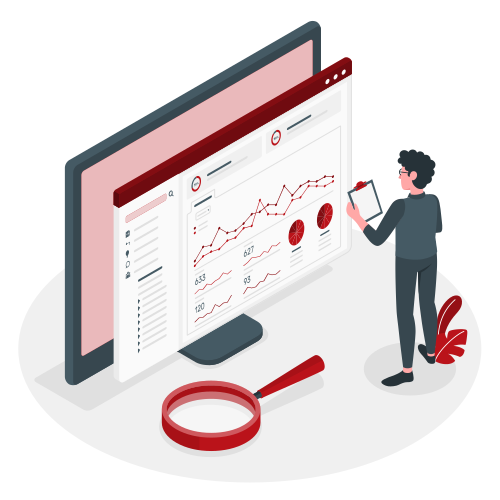
Ready to move from reactive to predictive?
Stop driving with your eyes on the rearview mirror. Let's build a predictive BI setup that gives your team a real view of what's coming and the competitive advantage that comes with it.
Frequently asked questions
BI predictive analytics is a branch of business intelligence that uses historical data, statistical techniques, and machine learning algorithms to forecast future outcomes. It helps businesses anticipate customer behavior, future trends, and operational risks, turning raw data analytics into actionable insights that drive informed decisions.
Traditional business intelligence tools focus on descriptive analytics, looking at the past and present to explain what happened. Predictive analytics looks forward: it uses predictive analytics models to estimate the likelihood of future events, answering questions like "Will this customer churn?" or "What will our sales be next quarter?" In short, traditional BI is reactive, while predictive analysis is proactive.
Not always. Many forecasting use cases work with structured Odoo data alone, using proven statistical techniques like regression analysis and time series models. You don't need an in-house team of data scientists to get started. AI and machine learning become valuable when you scale into advanced analytics, real-time scenarios, or large datasets with unstructured data inputs.
Common predictive analytics models include regression analysis, decision trees, classification models (used for fraud detection and customer segmentation), time series analysis, and neural networks. The right model depends on your business question, whether you're predicting customer demand, customer retention, or operational risk. We help you select and configure the right one during the audit phase.
Predictive analytics applies to a wide range of business outcomes: forecasting customer demand, optimizing inventory optimization, calculating customer lifetime value, driving churn prediction, detecting fraud, improving customer satisfaction, and refining marketing campaigns. Healthcare providers even use predictive analytics to identify patients at higher risk of readmission, improving patient outcomes and operational efficiency.
Implementation time depends on data preparation quality, scope, and the number of use cases. For a focused first model — like cashflow forecasting or sales projections — expect a few weeks from kickoff to a working prototype. Complex scenarios involving multiple data points, external sources, or machine learning layers may take longer. We always prepare data thoroughly before modeling, because high-quality data is the foundation of every reliable forecast.
You need clean, structured historical data inside Odoo, typically across sales, finance, HR, inventory, or CRM modules. The deeper and cleaner your history, the more accurate your forecasts. We audit your data readiness as a first step and help you prepare data to meet the standards required for trustworthy predictive insights.