BI for CRM and Sales: Get a clearer view of your pipeline
When customer information is dispersed across tools, notes, emails, and support interactions, customer relationship management becomes reactive instead of strategic. Sales teams navigate unstructured data, incomplete records, and inconsistent follow‑ups — making it difficult to forecast, prioritize, or understand what truly drives business performance. A Business Intelligence solution built for CRM helps you transform raw data into actionable insights, turning every interaction with current and prospective customers into a clearer understanding of how your pipeline performs and where your growth opportunities lie.
The Customer Relationship Management challenges that weaken sales performance
Most organizations recognize the importance of Customer relationship management, yet struggle to extract value from their CRM systems and CRM software. Common challenges include:
- CRM data scattered across disconnected tools, spreadsheets, and emails
- Sales teams logging activities inconsistently, creating gaps in customer interactions
- Pipelines filled with outdated opportunities and inaccurate probabilities
- Inability to compare sales performance over time or across teams
- CRM reporting that takes hours to assemble and still lacks depth
- Difficulty maintaining high customer engagement and customer retention
- Lack of visibility into the sales process, making strategic planning uncertain
- Limited understanding of customer needs due to missing or low‑quality customer details
These challenges prevent clear forecasts, weaken strategic planning, and slow business growth. BI CRM allows you to identify data sources, integrate them, and obtain the clarity needed for more efficient operations.
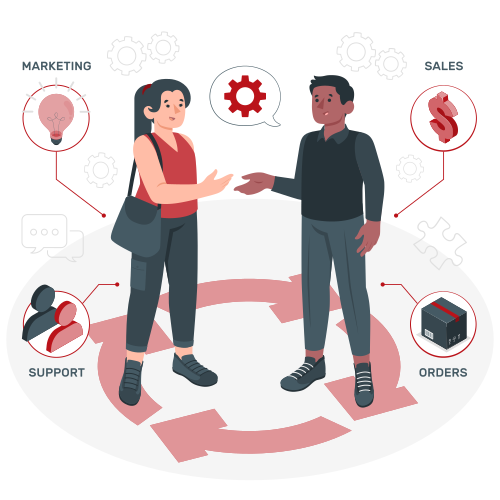
BI for CRM: building a connected and accurate view of your customers
Business Intelligence does not replace your CRM tools — it amplifies them. Where CRM captures customer interactions, BI CRM connects, consolidates, and analyzes them, revealing what truly drives business performance, customer satisfaction, and sales outcomes. Here’s how BI transforms the CRM experience:
See your full pipeline, including what’s usually hidden
A CRM alone stores information, but BI helps you visualize data across the entire pipeline. By combining CRM data with BI tools, you gain a unified view that shows how your pipeline truly behaves — what’s moving, what’s slowing down, and what’s silently at risk. This clarity helps sales managers and teams act on real activity, not assumptions. You gain visibility into:
- deal progression, probabilities, and durations
- inactive or stalled opportunities
- which leads deserve immediate attention
- which patterns impact your chances of closing
Here’s how this can show up in your day‑to‑day. Your pipeline looks full, but conversions aren’t following. A BI review shows that many opportunities haven’t had any recent customer interaction — deals that appear active but aren’t actually moving forward.
Understand what drives your sales performance
Sales analytics becomes far more powerful when CRM and BI are connected. With a clearer view of what influences your sales cycle, you can finally understand which factors truly drive your commercial results. Before diving into KPIs, BI helps you identify the underlying elements that shape your sales performance — the behaviors, patterns, and external forces that impact your outcomes. With this connected CRM‑BI view, you can:
- compare conversion rates across products, teams, or territories
- analyze sales cycle duration by rep or segment
- detect performance variations influenced by external factors
- highlight behaviors that correlate with successful deals
You may have experienced this yourself. You expect more activity from your team, but your CRM doesn’t reflect much. BI aligns CRM data with emails, calls, and tasks to reveal the real level of engagement — and where effort is missing.
Reveal patterns in customer behavior
With BI tools analyzing CRM data, you understand how customers move through their lifecycle. This deeper understanding makes it easier to see the signals that influence customer decisions, engagement, and long‑term value. Before segmenting or targeting, BI helps you see how your customers actually behave — what shapes their choices and where engagement weakens. You can identify:
- loyal or high‑value customers
- early churn risks
- actions that strengthen customer satisfaction
- segments based on behavior, value, or engagement
You might recognize a situation like this: Your churn rate increases, but you don’t see an obvious cause. BI uncovers that several high‑value accounts haven’t received any recent engagement — a signal that standard CRM views wouldn’t have highlighted.
Forecast revenue with confidence
Traditional CRM forecasting relies heavily on qualitative input. BI changes this by grounding your forecasts in real activity, historical patterns, and pipeline reliability — giving you a more accurate understanding of what’s likely to close. Before producing a forecast, BI grounds your projections in what actually happens inside your sales cycle — real activity, historical patterns, and pipeline reliability. BI CRM supports you with:
- forecasts based on historical data and real activity
- revenue projections aligned with pipeline health
- detection of deviations between expected and actual performance
- visibility into how internal and external factors impact future results
If you’ve ever struggled with unreliable forecasts, this will sound familiar: Your revenue forecasts consistently overshoot reality. BI shows that many deals have been open for too long to remain reliable, giving you a clearer, more grounded view of expected revenue.
CRM and sales KPIs that matter for decision‑making
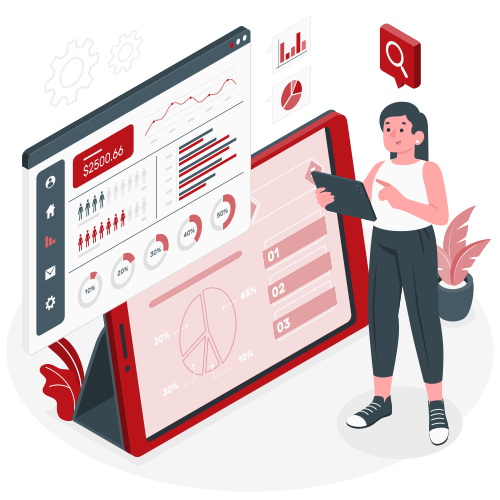
With BI CRM, you can track key performance indicators that truly reflect your commercial reality. These KPIs support leadership, sales managers, and frontline reps by aligning actions with business goals:
- conversion rate by pipeline stage
- win/loss ratio
- length of the sales cycle
- forecast accuracy
- average deal value
- customer satisfaction metrics
- customer retention and churn
- cost of acquisition and customer lifetime value
- volume and quality of sales activities
- engagement metrics across customer interactions
These KPIs don’t just measure performance — they deliver insights that directly strengthen business operations and guide better decisions.
Business Intelligence integrated with your Odoo CRM and customer processes
A BI solution becomes exponentially more valuable when fully embedded into your CRM integration and Odoo ecosystem. This approach allows you to:
- consolidate CRM data with order history, support interactions, and marketing touchpoints
- analyze customer details across all connected databases
- unify CRM and business intelligence to reveal cross‑team insights
- combine CRM with analytics for a full customer lifecycle view
- streamline processes by aligning BI systems with CRM workflows
- ensure BI tool integration supports your sales process end‑to‑end
You don’t need a complex infrastructure — just a BI solution that fits your CRM processes and business environment.
Our CRM‑focused BI approach
Every organization’s CRM reality is different. Our methodology focuses on clarity, alignment, and measurable impact rather than pre‑built dashboards.
Understand your CRM processes and customer lifecycle
We review how your teams interact with customers, how CRM data is captured, and how customer relations evolve.
Define KPIs and CRM use cases together
We identify your key benefits, business goals, and strategic needs to shape a BI model that supports your commercial objectives.
Implement BI within your Odoo CRM environment
We ensure the integration process aligns BI and CRM tools smoothly, connecting all relevant datasets without disrupting operations.
Support your teams and drive user adoption
We train sales teams, sales managers, and CRM users to use BI tools effectively — ensuring that valuable insights lead to data driven decisions and stronger performance.
Put your customer data to work for your sales strategy
Leveraging CRM and BI together is not about creating more dashboards — it’s about enabling more efficient operations, stronger customer relations, and better‑aligned commercial actions.
With the right business intelligence solution, your CRM becomes a strategic engine connected to your sales process, delivering insights that elevate customer experience and support overall business performance.
Frequently asked questions
BI CRM combines Customer Relationship Management with Business Intelligence to move beyond data collection. While a standard CRM records what happens during customer interactions, BI helps analyze why it happens and predict what is likely to happen next using data from multiple touchpoints. A BI CRM system also integrates interaction‑tracking with advanced data processing capabilities, allowing organizations to move from simple data capture to deeper analytical insights.
CRM and BI were designed for different purposes — CRM focuses on managing interactions, while BI focuses on analyzing performance. When combined, they create a complete view of customer interactions and business outcomes, enabling more informed and strategic decision‑making. BI tools can also pull data from multiple sources to create comprehensive reports, while CRM systems alone are typically limited to their connected databases, making integration essential for deeper analysis.
BI CRM uses historical CRM data and pipeline behavior to improve forecasting accuracy. Beyond improving projections, this analysis helps identify customer behaviors and preferences, allowing companies to refine sales targets, adjust strategies, and anticipate demand more effectively. In some cases, improved forecasting also supports better inventory planning and reduces operational waste. In practice, integrating CRM with BI can improve forecast accuracy by around 20%, supporting more reliable resource allocation and strategic planning.
BI provides deeper insights than standard CRM reporting by combining data from multiple sources. It enables teams to analyze customer behavior, identify trends, and apply predictive analytics to anticipate outcomes. These capabilities transform raw data into actionable insights and support more strategic decision‑making across sales and marketing activities. Key BI CRM capabilities include interactive dashboards, data visualization, and predictive analytics, which make insights easier to interpret and act on.
BI CRM helps sales teams focus on the right opportunities by analyzing deal activity, engagement levels, and conversion probability. It can also support automated lead scoring, helping prioritize prospects based on their likelihood to convert and improving overall pipeline efficiency. This includes AI‑driven lead scoring mechanisms that automatically qualify and rank leads based on their conversion potential.
By connecting CRM data with real customer interactions and sales activities, BI provides visibility into actual effort and engagement. This helps teams improve consistency, reduce missed follow‑ups, and align execution with pipeline priorities. In many organizations, CRM-based automation already reduces a significant portion of manual sales tasks, allowing teams to focus more on high‑value activities and improve execution speed.
BI CRM identifies patterns such as stalled deals, long sales cycles, or low engagement. Organizations using integrated CRM and BI approaches often see conversion improvements of 15–20% while also optimizing how sales and marketing efforts are aligned, which can reduce unnecessary acquisition costs.
BI aggregates data from CRM, sales, marketing, and support systems into a unified view. By consolidating interactions into centralized dashboards, teams gain a 360‑degree understanding of each customer, enabling better decisions and more consistent collaboration across departments. This consolidated view is often accessible through shared dashboards, ensuring that all teams work with the same information across the organization.
Yes. By analyzing engagement patterns and activity levels, BI identifies inactive opportunities and gaps in customer interaction. This allows teams to take action earlier and reduce lost deals.
BI CRM analyzes customer activity over time to identify churn patterns, engagement gaps, and potential risks. It also highlights opportunities for upselling and cross‑selling by examining historical behaviors, helping teams take proactive actions to strengthen customer relationships. By analyzing customer behavior, preferences, and purchase history, BI also supports more targeted actions that improve long‑term satisfaction and loyalty.
BI enables advanced customer segmentation based on behavior, value, and engagement. It also supports more personalized communication by helping deliver the right message through the right channel at the right time, improving both customer satisfaction and marketing effectiveness. Improved segmentation through BI can lead to measurable gains in customer satisfaction (10–20%) and significantly increase campaign effectiveness through more relevant targeting.
BI CRM allows tracking key performance indicators through visual dashboards and real‑time reports. These tools help teams monitor performance instantly, identify deviations, and make faster, data‑driven decisions. These dashboards provide continuous visibility into performance, helping both operational teams and leadership react faster to changes.
BI connects CRM data with other business data such as sales, accounting, and support systems. By consolidating data from multiple sources, it provides a unified, reliable view of performance and eliminates data silos across teams.
A successful BI CRM implementation requires identifying and structuring data sources, ensuring data quality, and defining relevant KPIs. It also involves continuously reassessing these KPIs to adapt to evolving business conditions and maintain alignment with strategic objectives.
The success of BI CRM is reflected in improved visibility, better decision-making, and stronger operational control. A well‑structured CRM combined with BI also improves customer satisfaction by enabling better understanding of customer needs, leading to stronger relationships and long‑term loyalty.