
Preserve the origin of every batch despite logistics disruptions
When a truck carrying raw materials is stranded for days on a damaged road, the problem goes far beyond a delayed delivery. In many cases, the real issue is the loss of critical information: who supplied the batch, when it was stored, and which stakeholders handled it before it reached your processing facility.
The Malagasy government has made this a national priority as part of its digital transformation initiatives. Food safety depends on the ability to trace a product throughout its entire lifecycle, from production to consumption. Development programs such as IFAD (International Fund for Agricultural Development) now include the implementation of traceability systems to strengthen agricultural value chains and help secure the revenues of agribusiness stakeholders.
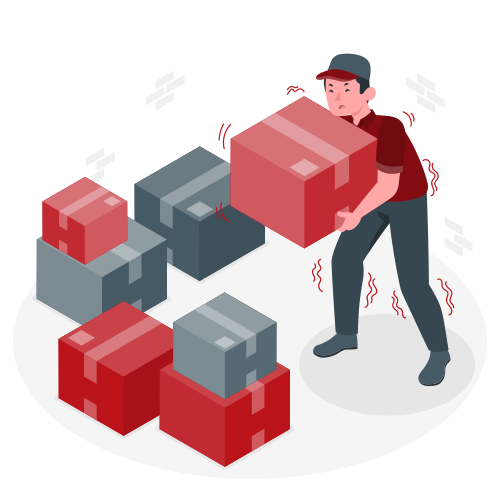
Traceability challenges unique to the Malagasy context
Whether you process rice, milk, sugar, flour, oils, or beverages, you all depend on the same fragile logistics network. Madagascar remains an island with rugged terrain, limited road infrastructure, and a strong dependence on the Port of Toamasina for trade. In practice, this results in situations you know all too well:
- Rural roads that become impassable depending on the season, between collection areas and production sites
- Unpredictable transport lead times between suppliers and factories, or between factories and points of sale
- Internet or power outages in certain areas
- Multiple intermediaries that make a batch’s history difficult to reconstruct
The challenge is not to eliminate these constraints, but to ensure they no longer affect the reliability of your data. The goal is to keep producing, delivering, and meeting customer requirements even when logistics conditions deteriorate.
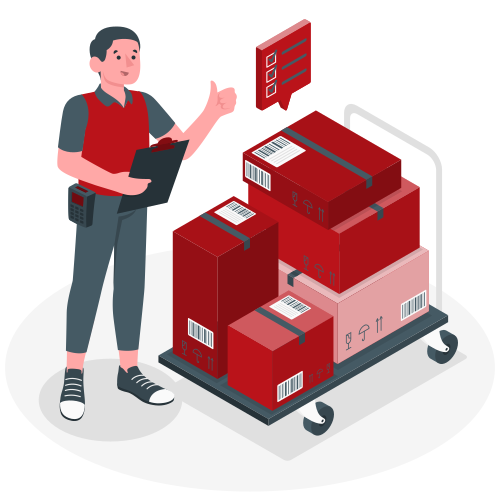
Ensure traceability of your raw materials from the moment they arrive
Whether you receive milk from multiple collectors, oilseeds from different producers, or sugarcane delivered by truck, the principle is the same: without traceability, mixing products upon receipt is enough to lose information about the origin of each batch.
With Odoo, every receipt can be:
- Identified with a batch or serial number directly linked to the supplier or collector
- Retrieved in one click: which supplier delivered which shipment, on what date, and in what quantities
- Isolated immediately in the event of a non-conformity, without blocking the rest of your inventory
You are no longer dependent on paper receiving logs that can be lost along the way or fail to follow the product throughout the entire supply chain.
Monitor every step of your production chain with precision
Once your raw materials enter inventory, they go through several processing stages: cooking, mixing, packaging, and packing. If a batch shows a defect at any stage, you need to be able to trace it back to the original raw materials without manually reconstructing its journey.
Odoo’s production dashboard, designed for the food processing industry, gives you that visibility:
- Real-time monitoring of the progress of each batch in production
- Forward and backward traceability: from a finished product, you can identify all the raw material batches used, and vice versa
- Immediate visibility into bottlenecks, allowing you to make adjustments before delays impact deliveries
You no longer need to wait for an end-of-day report to know the status of your production.
Control date tracking and inventory management through distribution
Once your finished products are in stock, whether they are canned goods, dairy products, beverages, or fresh products intended for export, shelf life becomes the key concern.
Odoo allows you to:
- Assign an expiration date and a best-before date to each outgoing batch
- Automatically apply a FEFO (First Expired, First Out) rule to reduce waste
- Receive alerts before a batch reaches its expiration date, allowing you to act in time rather than discovering the loss once the product is already in transit or on store shelves
In a market where logistics delays can already reduce a product’s usable shelf life, this visibility can make the difference between a batch being sold and a batch being lost.

Digital traceability does not eliminate damaged roads or network outages, but it prevents these challenges from turning into data loss, quality issues, or a loss of trust. Regardless of your sector, it is this continuity of information between procurement, production, and inventory that helps protect your business from the day-to-day challenges of operating in Madagascar.
Ready to strengthen the traceability of your products? Meet our experts at FIA & FIG 2026, from September 10 to 13 at CCI Ivato.