AI for Human Resources: How Artificial Intelligence is transforming the way HR teams operate
AI is transforming the HR role by automating key tasks, enhancing data analysis, and streamlining day-to-day decision-making. As a result, it has become a true operational ally—enabling HR teams to work faster, more efficiently, and with greater strategic impact.
Why Is AI Revolutionizing the HR Function?
Today, AI is reshaping how Human Resources teams carry out their responsibilities by simplifying day-to-day work and reducing the administrative burden. In this context, AI and HR form a powerful partnership. AI has become a key driver for:
- Automating repetitive tasks
- Analyzing and structuring increasingly large volumes of data
- Supporting HR decision-making
- Assisting employees and managers through AI-driven HR assistants

Key use cases of AI in Human Resources
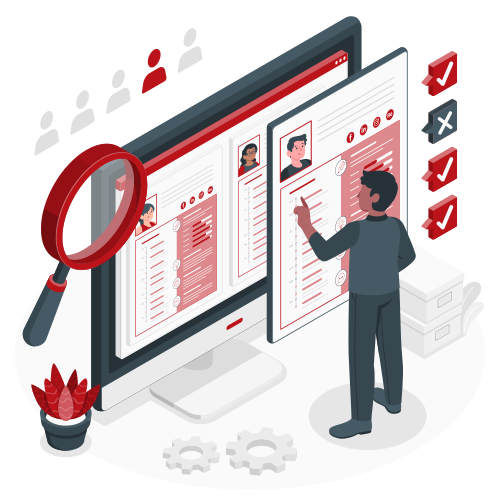
Recruitment Optimization (Talent Acquisition)
AI is fundamentally transforming how organizations identify, attract, and engage talent. Today’s solutions make it easier to:
- Automate résumé screening for more accurate initial shortlisting
- Leverage intelligent matching between candidate profiles and job requirements
- Use AI-powered HR agents to support recruiters with content creation, skills analysis, and candidate pre-qualification
- Deploy AI assistants to answer candidates’ questions, streamlining communication and enhancing the candidate experience from the very first interaction
Some talent acquisition practices also draw on AI techniques borrowed from marketing—particularly for personalization and behavioral analysis—further improving targeting and engagement.
Automating and Strengthening HR Processes
HRIS platforms enhanced with artificial intelligence are becoming true operational partners by enabling:
- Intelligent administrative management (leave tracking, contracts, HR documentation)
- Automated document generation powered by generative AI
- Reduced human error through more accurate and reliable data
Skills development and training
AI plays a critical role in the evolution of workforce skills by enabling:
- Personalized training recommendations tailored to individual career paths
- Integration of learning content through AI- and HR-focused MOOCs
- Creation of customized upskilling pathways aligned with employees’ needs and potential
These approaches allow organizations to better anticipate future skill requirements while offering more personalized and effective development support to employees.
Enhancing the Employee Experience
New AI-driven tools place employee experience at the core of HR strategies by enabling:
- AI assistants for handling frequently asked questions
- Personalized onboarding, mobility, and development journeys
- Well-being and engagement analysis tools capable of informing and guiding managerial actions.
These solutions help organizations foster a more supportive, engaging, and employee-centric work environment.
Predictive HR Analytics (People Analytics)
AI paves the way for a deeper understanding of human dynamics within organizations by enabling:
- Turnover prediction
- Early detection of human risks or sensitive situations
- AI-powered predictive HR models
- Support for strategic HR decision-making related to workforce planning, skills management, and organizational design
These analyses rely on the same technological foundations as AI-driven data analytics solutions, providing clearer insights into internal trends, and helping organizations make more informed decisions.
Tangible benefits of AI for cybersecurity
Artificial intelligence delivers concrete advantages in cybersecurity by improving threat detection, supporting security teams, and strengthening your overall posture against constantly evolving cyber risks.
Faster processing times
AI accelerates everyday HR operations by automating time-consuming tasks and reducing delays between each stage of the process.
Reduced repetitive work
Intelligent tools take over routine, repetitive activities, freeing HR teams to focus on higher-value, more strategic initiatives.
Improved Data Quality
Through better data structuring and automated checks, HR information becomes more reliable, consistent, and accurate.
More reliable HR decisions
AI-assisted analytics provide clearer insights into complex situations, helping HR professionals make decisions that are more informed, objective, and well-supported.
Cost optimization
By increasing automation and reducing redundancies and errors, organizations naturally lower the costs associated with HR processes.
Enhanced employee experience
AI enables faster, more personalized, and more consistent interactions, strengthening employee satisfaction and reinforcing the feeling of support throughout the employee journey.
Challenges, Limitations, and Key Considerations in Using AI for HR
Ethics and data privacy (sensitive information)
Handling sensitive data requires clear governance, enhanced transparency, and strong human oversight. HR leaders must remain vigilant about the implications of automation in HR decision-making, ensuring that AI supports—rather than replaces—human judgment.
Regulatory Compliance
European regulations impose strict rules on the use of AI in relation to personal data and HR processes. Organizations must ensure long-term compliance that is fully integrated into their HRIS and internal governance frameworks.
Employee Adoption and Acceptance
Adopting AI requires a gradual change in mindset, as some teams remain cautious about new technologies. The key challenge is to clearly demonstrate the tangible benefits of these tools without creating a perception of surveillance or a loss of autonomy.
The importance of maintaining human oversight
Studies consistently highlight the need to preserve human supervision in final decision-making, particularly in areas such as recruitment and performance evaluation. AI should enhance human judgment—not replace it.

How Does Captivea Successfully Deploy AI in HR?
Packaged and customized offering
1
Awareness and adoption
Captivea starts by providing access to the platform, ready-to-use AI agents, and comprehensive support to train your teams.
Objective: help teams understand use cases, take ownership of the tools, and generate quick, tangible results.
2
Industrialization
AI agents are refined and tailored to your HR processes: task automation, workflow integration, and customization of agent behavior.
Objective: make AI truly operational and valuable in day-to-day HR activities.
3
Scaling
The organization moves to a broader rollout, deploying customized and autonomous AI agents that cover a wider range of HR use cases.
Objective: increase impact, multiply use cases, and strengthen overall performance.
For custom‑built AI solutions
1
Analysis
An in-depth assessment of your needs, identification of priority use cases, and functional scoping of the AI project.
2
Integration
Development of a tailored solution, connection to your HR tools (HRIS, ATS, LMS, etc.), and preparation of the required data.
3
Live
Deployment of the solution, user testing, final adjustments, and rollout in your operational environments.
4
Monitoring
Ongoing performance tracking, continuous optimization, and feature enhancements to ensure a sustainable, high-performing AI solution aligned with your HR objectives.
AI is no longer just a tool—it has become a true catalyst for HR performance.
It enables automation, prediction, personalization, and continuous improvement of human experience within organizations. By relying on strong governance and a well-managed deployment strategy, HR teams can position themselves as key drivers of business transformation.
Preguntas frecuentes
Modern ai tools support hr teams by accelerating hr tasks and reducing repetitive tasks across hr operations. These ai tools help hr professionals automate routine tasks while improving hr functions in hr departments through ai driven insights and data driven decisions.
Ai in hr enables hr professionals to leverage ai for administrative tasks and performance management while allowing hr professionals to focus on employee engagement and employee development. Ai in hr improves hr data quality and supports hr departments through adoption and ai literacy.
Hr leaders rely on hr ai because ai technology supports talent management while aligning hr functions with business objectives. Ai technology continues to evolve, driving ai investments and expanding ai capabilities across human resource management.
How ai improves the recruitment process includes resume screening and interview scheduling powered by ai systems and machine learning. How ai supports the hiring process includes optimizing job postings and attracting top talent through natural language processing and ai generated insights.
Generative ai enables drafting job descriptions and refining job descriptions using generative ai capabilities and training data. Generative ai also supports talent development and continuous learning by mapping employee skills to workforce planning needs.
How ai strengthens employee engagement includes improving hr communications and collecting employee feedback across the entire employee lifecycle. These data driven insights help hr teams combine human intelligence with ai models while maintaining the human element.
Natural language processing extracts insights from hr data, employee data, and employee records while supporting performance reviews. Combined with natural language processing, AI driven insights and data driven insights enable better performance management decisions.
Successful ai adoption depends on ai fundamentals, ai literacy, and ai governance within hr departments. Implementing ai responsibly requires controlled ai use, protecting workforce data and complying with data protection regulations.
Ai use enhances hr tasks by assisting hr professionals through ai systems while preserving human intelligence. Allowing hr professionals to interpret ai generated insights ensures ai capabilities complement — not replace — human intelligence.
Ai tools support administrative tasks while improving data privacy and securing hr data. These ai tools rely on training data and employee expectations to balance efficiency, compliance, and trust.