
Marketing and communications: get a campaign page live without the wait
Pages created from a simple description
When a campaign is coming together, your team needs to get a page online quickly, without depending on the technical teams’ schedule. The AI Website Assistant has received a series of improvements to help with this: you describe what you want in plain language, with no code to write, and it chooses and edits snippets, adds images from Unsplash or generates them, and can retrieve content from the web. When creating or editing a page, it can now:
- Create new pages: you can now ask it to create a new webpage
- Draw on your database: it uses your records, such as products or events
- Take inspiration from other websites: it can also replicate a page on your website from a URL you provide
- Add interactive elements: counters, tabs or animations
For a services business running a webinar or an open house, the event page can draw on the event already recorded in Odoo instead of having its details typed in again.
Targeted edits your team can make on its own
The assistant can also create or edit your web forms and make changes to your menu: creating, renaming, moving, nesting, reordering or deleting items. The "Select Elements" option lets you point it to the exact block your request is about, which cuts down on back-and-forth. These everyday adjustments, which could otherwise mean a request to the IT team, become something your marketing team can handle directly. To help you stay in control of your content, the Website editor flags the building blocks that were generated or modified by the assistant, so your team knows which ones to review before publishing. Your Odoo website can then keep pace with your campaigns and offers.
Incoming requests: web forms that help your team qualify leads
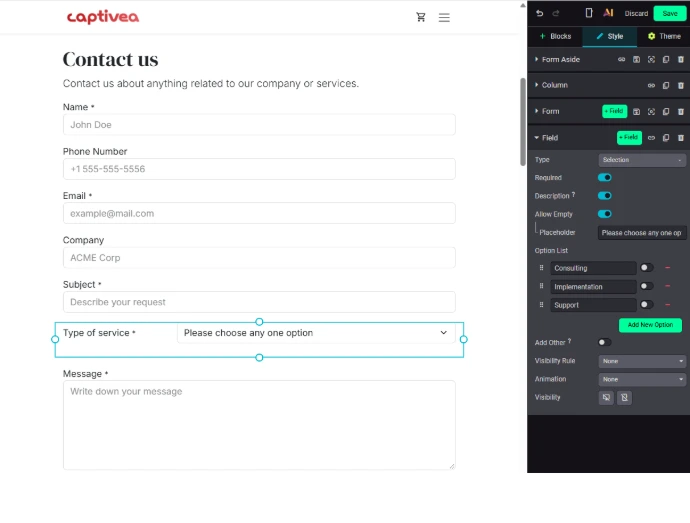
Qualifying incoming requests takes time when the information received is incomplete or poorly filled in. For a services business, the contact or quote request form is often the main way in: the better it is designed, the less your marketing and communications team has to follow up before passing a request on to sales. Odoo 20 gives you more control over the information collected:
- Dropdown lists: they can be set with no default value, so visitors have to choose, for example, the type of service they are interested in
- Text fields: they accept character limits
- File uploads: they can be restricted to certain file types
- Email addresses: submissions can be limited to certain domains
Field labels can be edited directly in the form, and inner content can be dragged between fields to create sections or set titles. For visitors who prefer an immediate exchange, a new WhatsApp widget snippet lets them start a conversation with your business in one click: structured requests go through the form, quick questions through a direct channel.
Google: stronger Odoo website SEO from the ground up
Structured data added by default
For search visibility, the most notable change is this one: Odoo 20 now adds structured data by default to the HTML of your web pages. This information helps search engines interpret your content and opens the door to Google rich results, with no specific setup required from your team. Two technical refinements round out this foundation: responsive image sizing (srcset) improves mobile performance, and the SEO logic has been refined to avoid duplicate content on paginated pages.
AI to rework the SEO of your pages
Odoo 20 also lets you use AI to improve the SEO of a web page. It is a useful aid for reworking existing content, as long as your team keeps an editorial eye on the suggestions. One point to plan for: all Odoo 20 AI features, including the website assistant, now require credits, which can be purchased through IAP. To go further, take a look at our approach to Odoo SEO.
AI assistants: a site that is easier to read with llms.txt
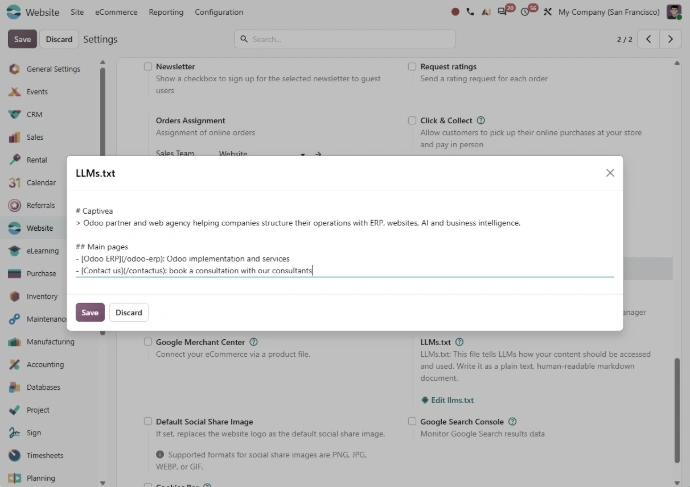
Search engines are no longer the only way to find information online: some people also turn to AI assistants with their questions. Odoo 20 takes this into account with a new feature that is simple to set up: you can create an llms.txt file directly in the website settings. This file helps large language models better understand and use your website content. It is a complement, and does not replace careful work on the content of your pages. In the same vein, when a link to your Odoo website is shared on a social platform, a preview card is now displayed.
Audience tracking: simpler campaign measurement for your marketing team
Tracking your audience is part of your marketing and communications team’s daily routine: knowing whether a campaign page is drawing traffic, whether an action is bringing in visits. Google Analytics or Google Tag Manager can now be set up from a single ID field in the Website settings. Connecting the site to your analytics tools is handled in the same place as its other settings, with no separate technical step.
Odoo 20: where to begin with your website
Not every new feature has the same impact for your team. Priorities depend on the role your site plays:
- A site that generates enquiries: the webform improvements and the WhatsApp widget deserve a place at the top of your action plan
- A site you update often: the AI Website Assistant can lighten the work of creating and updating pages
- A visibility challenge: structured data, the technical SEO improvements and the llms.txt file deserve a close look first, bearing in mind that no single setting guarantees a ranking
The most effective approach is to start from how your marketing and communications team keeps the site running today: the pages it publishes, the requests it handles, the changes it still has to wait for technical teams to make. For a services business, where the website is first a source of enquiries, that day-to-day reality should guide which features to turn on. Whether you are planning to create an optimised website or improve the one you already have, Odoo 20 brings together the tools to build it and make it visible.

Is your website generating the enquiries your services business needs?
Speak to our consultants to review the visibility of your Odoo website and identify the Odoo 20 features that will give your marketing and communications team more autonomy.