Unify your data to regain control of your business
Centralize your information with an integrated ERP-CRM system
When data is fragmented, management becomes arbitrary. When it's centralized, it becomes manageable. An integrated ERP-CRM system allows you to consolidate customer data, sales, operations, and financial flows into a single, cohesive environment. No more cross-referencing Excel sheets or wondering which version is the correct one: you work on a unified, reliable, shared foundation.
Avoid information fragmentation with ERP-CRM integration
Your teams are moving fast... but often in different directions. The sales team spots an opportunity. Finance is waiting for an order. Operations discovers the file too late. ERP-CRM integration ensures everyone is on the same page. Each department has access to the same information at the right time, without relying on time-consuming internal exchanges.
Transform your teams' efficiency with ERP-CRM synergy
Centralize Customer relationship management to act smarter, not just track better
A good CRM isn't just for storing contacts. When combined with an ERP, it becomes a business management tool. Your teams finally have a complete view:
- Interaction history,
- Quotes and orders,
- Financial status,
- Ongoing actions.
The result: more relevant actions, better-targeted follow-ups, and a more consistent customer relationship, no matter the point of contact.
Automate your processes to eliminate internal friction
Every re-entry of data is a risk. Every manual operation is a waste of time. With an integrated ERP-CRM system, processes flow naturally, without disruption or guesswork: an opportunity becomes a quote, then an order, and finally an invoice. You reduce errors, speed up cycles, and give your teams back the time they need to focus on what matters most.
Odoo: A pragmatic approach to integrated ERP-CRM
Odoo simplifies ERP-CRM integration without unnecessary complexity
Odoo doesn’t stack independent modules. It creates a cohesive ecosystem, where Odoo CRM and ERP components share the same data logic. What this means in practice:
- A gradual implementation,
- A seamless flow of information,
- Quick adoption by your teams.
Odoo thus stands as a credible alternative for businesses seeking integrated, flexible, and manageable ERP solutions.
A customizable ERP-CRM aligned with your real-world needs
Your business is unique. Your tools should be too. With Odoo, you can tailor processes, fields, and business logic to fit your actual needs, not a theoretical model. You gain relevance, ease of use, and operational efficiency.
Successfully integrating ERP-CRM: where everything happens
Customize your tools without overcomplicating them
A successful integration isn’t about transforming everything. It’s about aligning the solution with your business priorities. Clarifying your needs, structuring your workflows, and avoiding unnecessary complexity ensures you get a tool that's truly used—rather than a system that gets bypassed.
Involve your teams from the start
Technology alone is never enough. Without support, even the best ERP-CRM will remain underused. Training, explaining, and demonstrating tangible benefits are what enable smooth and lasting adoption. This is often where the difference is made between a project that's endured and a project that creates value.
Integrated ERP and CRM: A strategic lever, not just a tool
Why does this combination have a lasting impact?
An integrated ERP-CRM system isn’t just about better management. It enables you to anticipate, make better decisions, and adapt faster. By structuring your data and processes, you improve internal visibility, responsiveness, and your ability to meet customer expectations.
Choosing an ERP-CRM solution focused on growth
The right solution isn’t the one with the most features. It’s the one that adapts to your organization, evolves with it, and enhances your performance over time. A well-integrated ERP-CRM becomes a strategic tool, not just software.
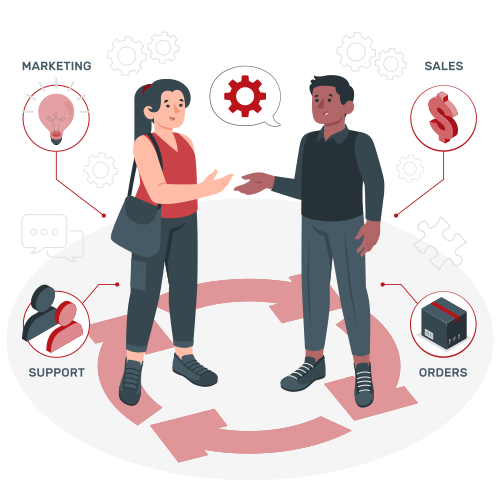
By integrating ERP and CRM, you bring coherence to what was once fragmented data. It also empowers your teams to work more efficiently, with a clear and shared vision. In an environment where agility makes all the difference, this integration is no longer an advantage. It's a prerequisite for confidently steering your growth.
Frequently asked questions
A CRM focuses on customer relationships: prospects, opportunities, sales tracking, and interactions. An ERP manages the entire business: sales, invoicing, purchases, inventory, finance, operations. On their own, each fulfills its role. But when integrated, they allow you to track a customer from the first contact through to invoicing, with no gaps in information. This is where the value is created.
Because two disconnected tools inevitably create:
- Data duplication
- Manual data re-entry
- Gaps between commercial and operational realities
An integrated ERP-CRM ensures smooth data flow between teams. What sales promise is exactly what the business can deliver and invoice, with no approximations.
There is no strict threshold based on the number of employees. The real indicator is the complexity of your workflows:
- Multiple tools
- Difficulty tracking sales end-to-end
- Lack of visibility into profitability or sales performance
Once these signals appear, ERP-CRM integration becomes a structuring tool, even for small businesses.
Beyond theoretical benefits, the concrete advantages are:
- A unified and reliable customer view
- Shorter sales cycles
- Fewer invoicing errors
- Better team coordination
- Decisions based on real data, not intuition
In short: less friction, more control.
Odoo is built on a natively integrated modular architecture. The Odoo CRM shares the same database as the ERP modules (sales, invoicing, inventory, accounting). The result:
- No complex synchronization
- Real-time consistent data
- Gradual evolution, module by module
This is a key advantage for businesses seeking flexible ERP solutions without excessive rigidity.
Yes, as long as it is configured intelligently. Odoo allows you to:
- Adapt processes
- Customize fields and workflows
- Integrate industry-specific logic
This customization ability is crucial to avoid a generic tool being poorly utilized. The goal isn’t to have more features, but the right ones.
The challenges are rarely technical. They are often related to:
- A vague definition of needs
- Poorly formalized processes
- Insufficient adoption by teams
A successful project relies on a clear vision of objectives, prioritization of key issues, and proper change management support.
Absolutely. Even an intuitive tool requires time for proper adoption. Training helps:
- Align usage
- Reassure teams
- Fully leverage the system's potential
Without training, the risk is that the ERP-CRM is bypassed, underused, or poorly exploited
It depends on the scope of the project. A gradual approach is often the most effective: start with the CRM, then connect the key ERP processes. This deployment method allows you to quickly generate value while ensuring long-term adoption.
Ask yourself a simple question: Does this tool adapt to my organization, or does it force me to adjust my processes around it? A good ERP-CRM solution should:
- Support your processes
- Evolve with your business
- Enhance your ability to manage, not complicate it.