
Spark a revolution, not a war! Before you start shaking things up in your company, it’s important to help employees understand the benefits of digital transformation that come with the deployment of an ERP system. Rolling out such software across an organisation requires a well-planned change management process so that the entire company can move in the same direction.
To handle any resistance you may face, your company’s choice of ERP and deployment plan has to be strategic. Here are some tips on how to manage change calmly and effectively in your organisation.
An ERP That Brings Structure,
Yet Adapts to Your Processes and People
History has shown that the most significant revolutions are not always the most radical. As we’ve seen, an ERP plays a major role in a company’s digital transformation.
However, integrating management software should never create a radical break in the organisation. Like any newcomer to the team, the ERP must first fit into the company’s dynamics before gradually adding value. An ERP service provider can help facilitate this integration.
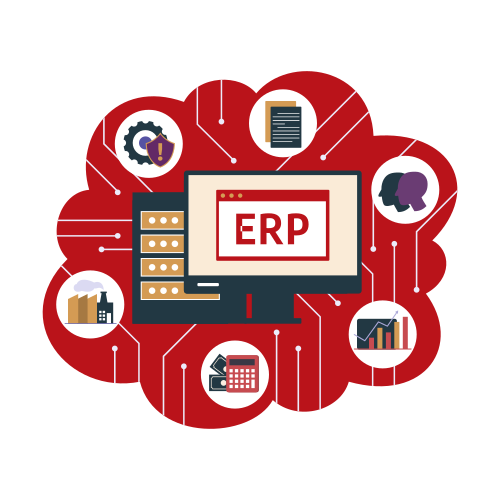
So, before implementing an integrated management software suite in your organisation, it is essential to “market” the project. You need to let employees know that changes to internal processes are coming, and that they will be involved in redesigning them. Clear communication and involvement are the keys to success.
If you don’t communicate and you run your ERP project on your own, there’s a good chance you’ll end up being the only one using it. ERP can sometimes be seen as a kind of “Big Brother” that monitors everything employees do, or as a robot that will replace them and cause job losses. That’s not the impression you want to give.
To get off to a good start, the ERP must first fulfil its role as a data centraliser and a facilitator of information exchange. Employees should see the ERP as a practical tool designed to optimise their performance, not as a bad omen that will disrupt their current workflows. This is why a smooth integration includes involving employees in the overall process of organisational transformation.
An ERP That Smoothly Supports the Radical Changes Brought About by Digitalisation
To address employees’ resistance to change in the face of digital transformation, you need to deal with the concerns that are holding them back. At this stage, communication should focus more on management issues and less on technical explanations about implementing IT solutions. Employees must feel involved. And to get involved, they need to be motivated!
To find a motivating angle that will really speak to your teams, you can use Victor Vroom’s Valence / Instrumentality / Expectancy framework (1964). Of course, you’ll need to adapt it to your own context.
For example, having an ERP will give the sales team visibility and traceability over their actions. This helps them properly assess their chances of success in their projects (Expectancy).
Then, with the CRM being integrated into the ERP, they will have an effective solution to keep them constantly updated with prospect follow-up and provide relevant data on the people to contact, ultimately maximising their chances of closing sales.
Their sales success will enable them to increase their commissions (Instrumentality). In addition, the features offered by an ERP will give employees more value in their work (Valencia), by automating menial and time-consuming tasks.

Although digitisation somewhat implies delegating part of the company's management to software, the employee must remain at the heart of digital transformation concerns. Management and employees are not just witnesses to the transformation, they are the main actors. By integrating new technologies and new market requirements, businesses are reinventing themselves; literally transforming the company.
Are you ready to start the digital transformation of your company with an ERP?
Join us and make your company a better place.