
Are you torn between an ERP (Enterprise Resource Planning) and a specialised information system to help manage your business processes? Don’t worry, we’re here to demystify it all! The decision might seem complex, but understanding these two solutions and their differences can help you make the best choice. So, let's dive right in!
What’s an ERP?
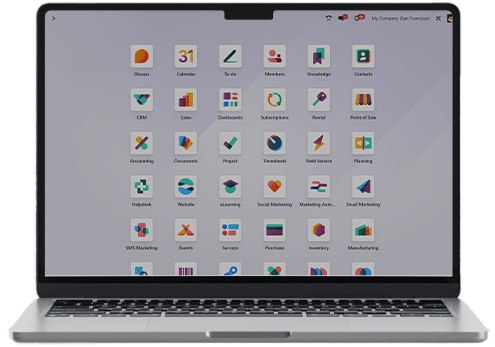
An ERP software An ERP is like the superhero of management systems. It centralises all your essential core business functions, much like a Swiss Army knife, covering everything from accounting and human resources to sales and purchasing. Think of it as the brain of your business, integrating all data and processes into one unified platform. Its main advantage? Total visibility into your supply chain, production and business operations, which enhances decision-making and boosts efficiency.
In addition to providing a unified view of your company’s data, an ERP aims to automate your processes and improve communication across departments. This integrated management software acts like the engine of a car: it makes all the parts work together seamlessly, orchestrating every movement with precise efficiency.
What’s a specialised information system?
An Information System (IS) is a broader concept. It covers all the tools and processes used to collect, process, and distribute information (customer data and others) within a company. Specialised ISs, on the other hand, are like experts in specific fields. They might be dedicated to areas such as production management, human resources, or accounting operations, to name a few. If your business has more specialised needs, these systems provide tailored solutions designed to fit those exact requirements.
Unlike an ERP, which is versatile, a specialised information system is like a specific wrench: it’s designed to perform a very precise job. If you deploy multiple specialised systems, you benefit from having experts in their respective fields, though they may not always be connected to each other. They function as more detailed and tailored systems for operations related to your business or industry.
Specialised information systems are divided into various categories:
- Human Resource Management Systems (HRMS): For managing employee-related processes such as recruitment, career management, payroll, training, etc.
- Manufacturing Resource Planning (MRP) Systems: For planning and controlling production.
- Accounting Systems: Focused on financial management, accounting, and related operations.

What are the advantages and disadvantages of each solution?
As management tools, ERPs and information systems differ in their approach and flexibility. ERPs are classified as horizontal software, designed to be flexible and adaptable to various industries and the diverse management needs of businesses of all sizes.
On the other hand, specialised information systems are considered vertical systems (sometimes referred to as vertical ERPs or industry-specific ERPs), with features tailored to meet the very specific needs of industries such as distribution, manufacturing, retail, etc. Let's explore the advantages and disadvantages of each solution in the comparative table below.
Comparative points | Specialised IS | ERP |
Main objective |
|
|
Usage |
|
|
Functional scope |
|
|
Implementation |
|
|
Integration |
|
|
Data management |
|
|
Maintenance and support |
|
|
Flexibility |
|
|
Adaptability to growth |
|
|
Cost |
|
|
And why not combine them?
Sometimes, the best of both worlds really is… both! A hybrid approach can bring together the power of an ERP with the specialisation of an IS to cover all your company’s needs. You can use an ERP as the backbone while adding specialised systems for targeted functions. This lets you maximise efficiency while gaining the flexibility and precision your industry requires.
How does it work?
Imagine an ERP as the main engine of your business. It centralises key data and processes, giving you a comprehensive, integrated overview. But sometimes, this engine needs a few enhancements to excel in specific areas. That’s where specialised information systems come in. They act as complementary components, adding targeted features and expertise where the main engine may lack precision. You get an integrated overview with the precision of specialised expertise, staying agile while tapping on the strengths of each solution.
So, how does this hybrid solution work in practice? Here are the key points to take note of:
- Seamless integration: Modern ERPs are often designed to be flexible and modular. This means they can integrate specialised IS through interfaces or APIs. For example, an ERP might handle accounting, sales, and purchasing, while a specialised IS could manage advanced production or human resources functions. Seamless integration ensures smooth data flow between systems, reducing information silos and ensuring data integrity and consistency. Typically, a connector is used to allow specialised information systems to feed data into the ERP.
- Advanced customisation: By adopting a hybrid approach, you can tailor your technology environment to meet your specific needs. You benefit from a robust ERP solution for core functions and specialised applications for areas requiring more precise expertise. This customisation provides solutions that are perfectly suited to your needs without sacrificing integration and operational fluidity.
- Risk and cost reduction: Instead of choosing between two systems that do not fully meet your needs, a hybrid approach leverages the strengths of each solution while minimising their weaknesses. You reduce the risks associated with adopting a single system that may not be perfectly suited and optimise your investments by utilising specific functionalities where they are most needed.
How does it work in practice?
Let’s illustrate this technological synergy with a concrete example. A manufacturing company might use an ERP to manage its finances, sales, and purchasing. However, to handle the complexity of its production lines, it could integrate an MRP system. This specialised information system can offer advanced features such as production planning, inventory management, and preventive maintenance, which often go beyond the capabilities provided by an ERP alone.
Consider another scenario. A retail company might use an ERP system ERP system to manage its sales operations, inventory management, and logistics. However, for more complex and precise accounting needs such as handling tax filings, consolidating accounts, and performing detailed financial analysis, it could integrate a specialised accounting system.
Conclusion
Choosing between an ERP and a specialised information system depends on your needs and business goals. According to our comparison of ERPs versus specialised information systems, ERP systems provide an overview and automation of your processes, while specialised management information systems offer targeted expertise. Assess your priorities, budget, and goals to make the best choice. However, don’t limit yourself to just one solution if you can benefit from both! A hybrid strategy allows you to tailor your information system or software solution to the growth and evolution of your business while improving your processes and performance.
Ready to take the plunge? Let’s explore the best options for your business together!
Captivea, as leader of Odoo implementation worldwide is the best partner that you can choose!
Don't hesitate to contact us!