
The project management challenge of finding the right balance between freedom and structure has always been a tricky issue for businesses. Too much flexibility can often lead to total disorganisation. But making processes more rigid to obtain a clearer view of project stages can make internal organisation more cumbersome and discourage project members. So, is it better to create your own project management tools in an Excel spreadsheet or rely on market-leading Task Management Software (TMS)? The ideal would be an in-between solution that lets you add structure to your business and enjoy the benefits without sacrificing agility and the uniqueness of your existing processes...What if such software existed?
The winning balance between organisation and agility
Project management is an essential component of any company’s structure. Without it, there’s no collaboration, no constructive brainstorming, no action plans...Nothing. At first, managing a project may seem simple: it’s just a sequence of steps and tasks to be carried out in order to successfully complete a project. However, when you take on the role of project manager, you quickly realise that effective management is more complex than it seems. There are several challenges that may arise: time zone differences, conflicting schedules, tools that inhibit effective collaboration or even the constant backtracking that is common in the early stages of a project’s lifecycle.
Some chose to avoid using any software and instead use Excel spreadsheets to track progress and divide up tasks. Others rely on whatever functions are available on the company intranet. Colleagues may use instant messaging services such as Slack or internal social networks such as Yammer that offer group creation features. But once you reach a certain size or number of projects, these methods quickly become unmanageable, and it becomes necessary to invest in dedicated TMS software. This makes it possible to streamline certain workflows, simplify and even automate some tasks. In short, it is a way of structuring project management so that everyone can easily find what they need. However, be careful not to compartmentalise and standardise everything; if you overdo it, you risk completely losing your ability to adapt and evolve.
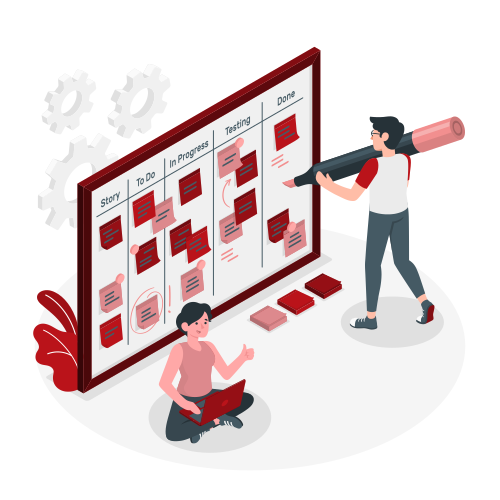
Putting good practices in place to boost productivity
There are dozens of TMS software solutions on the market: Trello, Taskworld, Asana, Monday... Each solution has its pros and cons, but lack of flexibility remains the most commonly cited shortcoming. Very often, deploying a task management solution means the company has to follow its way of working. This can lead to a significant loss of agility. This lack of customisation can then turn into an administrative burden and push employees to fall back on their old methods. And let’s be honest, this is far from ideal.
So how do you find management software that fits your organisation perfectly and allows you to put good practices in place? Let’s take a look at Odoo... The Odoo team has built agility into Odoo’s DNA. Odoo’s ERP suite works like building blocks, allowing companies to digitalise according to their needs and add components as they grow. Each module, including the project management module, is also highly adaptable. With Odoo, you will be able to take advantage of all the key features of a successful project management software (Kanban, Gantt, shared calendars, deadline management, implementation of indicators, etc.) without losing sight of your organisation’s specific processes. Another significant advantage of Odoo? Interconnection.

Create an interconnected digital ecosystem
By choosing Odoo for project management, you are overcoming a huge obstacle: bridging your task management software with the rest of your ecosystem. Deciding to integrate a standalone software solution would require a lot of programming to connect it to existing systems. ERP, CRM or PLM (Product Lifecycle Management) software. You would have to manually import or export each file, or key in the same data multiple times. In this situation, the risks of IT errors increase and users will quickly abandon these tedious processes just to make their lives easier.
The advantage with Odoo is that you can create a Digital Workplace effortlessly: connect production with project management, accounting, HR, event management, and more. Odoo has a vastly diverse suite of modules that offers endless possibilities.

The Odoo advantage for project management
One of Odoo’s biggest advantages for project management – as we’ve mentioned throughout this page – is its high level of customisation. For example, you can customise the Kanban view and group tasks by stage, person in charge, deadline and more. You can also change the titles of each section and create specific steps for every project. Odoo also comes with in-depth analytics capabilities, so you can closely track the profitability and performance of every project.
Captivea Odoo Gold partner
Captivea is an Odoo Partner supports companies in Odoo integration. Captivea is an Odoo Gold Partner and Odoo Certified.