
If you’re in charge of managing inventory, you know how difficult and complex the task can be. Your job includes figuring out how to optimise inventory, coordinating carrier schedules and keeping up with inventory nuances (fresh products, special packaging, etc.), and that’s just a small part of the job! There’s an overwhelming number of elements to take into consideration and while they are what makes this job so interesting, they are also the reason why this job can be so complex. Fortunately, there are software solutions available that can make your life easier, in particular Odoo’s software. Let’s take a look together.
Fast and reliable stock management
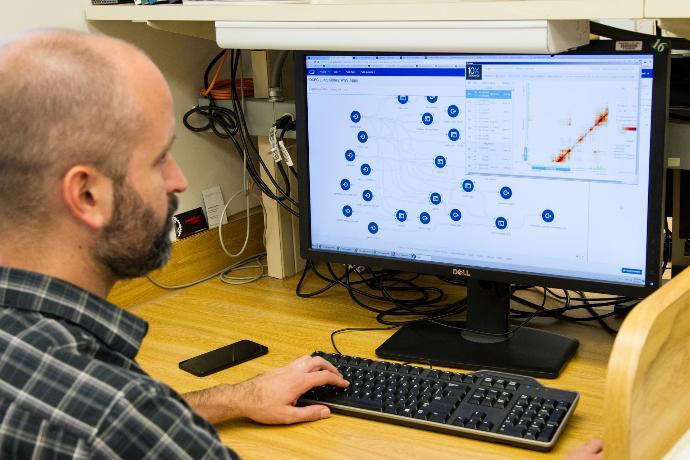
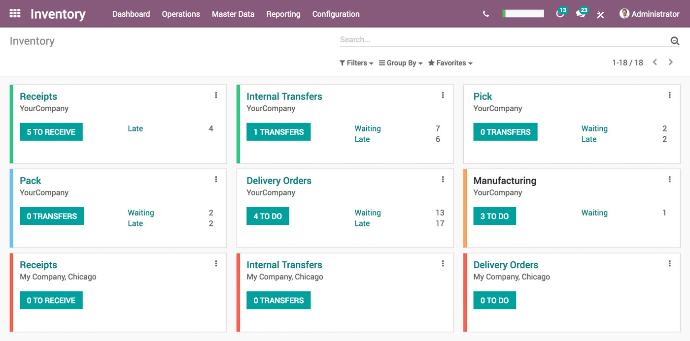
The goal of inventory management software is not only to simplify your daily work, but also to help increase revenue. For this to happen, your data needs to be centralised in one place. This is exactly what you get with Odoo, where you can manage all your inventories and product flows within the same tool, even if they come from different warehouses or customers.
Odoo’s intelligent double-entry inventory system ensures real data reliability and cuts down the amount of time needed to complete tasks. In fact, with Odoo, you no longer have to perform manual re-entry: there is no need to enter stock removals or changes. Thanks to Odoo’s system, all these operations are tracked by inventory movements between available storage locations.
Enable enhanced anticipation with alerts and automation
Of course, we all know that inventory management is a long-term game. Ideally, everything runs smoothly, but every day we run the risk of unexpected events disrupting this well-oiled machine. Imagine if your carrier went on strike – your warehouse would be filled with unmoved inventory. Add bad weather and flooding to the equation and your inventory could be damaged. A prolonged power outage and the entire cold chain process can be called into question. As you can see, there are many small parts that can fall out of place and disrupt the system you work so hard to maintain.
Of course, the unforeseeable events that we have just mentioned remain beyond your control. You will have to deal with these unexpected events by having specific safeguards in place (having an emergency power supply and monitoring and reinforcing the building, for example).
However, for those events that are manageable, you might as well set up a system that helps you anticipate them. This is what you get with Odoo's customisable alerts. You can, for example, create alerts for products or suppliers that appear when a seller creates a quotation. Additionally, thanks to Odoo's automation features, you can choose to generate purchase order proposals when a minimum inventory count is reached to replenish your supplies. The same goes for supplier negotiations: if you want to negotiate a price with your suppliers for each specific purchase, an automatic request for a quotation can be triggered as well.
Routing, the cornerstone of inventory management
Of course, no one wants inventory management software that lacks a powerful routing function. The creators of Odoo understand this well, which is why they have developed advanced warehouse management features for Odoo. Drop-shipping, cross-docking and multi-warehouse management all come built in with Odoo’s ERP software.
With Odoo, you can also define your own storage and pickup strategy: FIFO, nearest available location, LIFO, and more. The same applies to the ordering process: you can choose to deliver to your customer in a single step (delivery note) or break the workflow into stages (collection, packing, dispatch). Your product routes and “push & pull” routes can also be customised so you can automate transfer orders between warehouses and locations.
The Odoo advantage for inventory management
For inventory management, one of Odoo’s key advantages is its ability to interconnect. It links not only with the rest of the Odoo suite, but also with carrier software from UPS, USPS, FedEx or DHL. And if you work with another carrier, your integrator can easily set up the connection. Captivea has, for example, developed connectors for Colissimo, TNT and Chronopost. Thanks to its powerful API, the Odoo warehouse management system can handle almost anything you need: integration with 3PL providers, hardware integration (scales, scanners, RFID) and more.

Captivea Odoo Gold Partner
Beyond inventory, Captivea, an Odoo Gold Partner, supports companies in enhancing their factory production and overall performance.