Traditional BI dashboards: When the tool no longer matches the needs
Take a look at how your teams actually rely on dashboards daily. The data is accessible, the indicators are there, yet the operational pace is faster than the time it takes to read through them. Traditional dashboards still follow slow cycles, while teams need to react in real-time. The dashboard tells what has happened, while the business is handling what is currently unfolding.
This issue becomes even more apparent when you look at the screens. Many dashboards are built around available data, not around the questions teams are truly asking. Charts follow one another, indicators multiply, sometimes very precise, but difficult to connect to a concrete decision. Time is spent reading, searching, and comparing. Attention gets scattered. What’s truly important doesn’t appear clearly.
In the end, these dashboards are opened for a few moments and then closed. They remain in the background of daily decisions. The problem doesn’t lie with the tool itself. The technologies work. What’s missing is the sense of immediate usefulness. The numbers show the what. The why is barely visible. And the question "what do we do now?" often remains unanswered.
Faced with this situation, many teams end up working differently. They open Excel, recreate their views, and manipulate the data their own way. Not because they prefer it, but because it allows them to move faster, to test, and to explore different options. As long as the dashboards don’t offer clear context, guided reading, or easily exploitable signals, practices will adapt.
In 2026, with the rise of "decision intelligence" and AI agents capable of interpretation and prioritization, this limitation becomes hard to ignore. Expectations have evolved. So have the needs. Static dashboards now struggle to keep up.
Data visualization in 2026: From number reading to decision-making
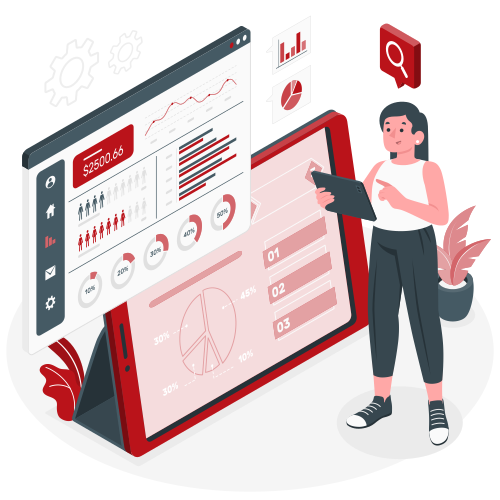
When you consult a dashboard today, your main expectation is immediate readability. In 2026, data visualization meets this expectation through clean interfaces focused on what matters most. Every element displayed serves a specific purpose: to grab attention, provide direction, and facilitate decision-making. Quick understanding takes priority over the accumulation of indicators.
The value of a visualization also depends on your role. The same number means different things to a manager, an operations lead, or an executive. The moment is as important as the role. Current dashboards adapt to these factors and highlight what matters most to you at the moment you access them.
The challenge is no longer just about exploring data, but about effectively prioritizing it. Graphs remain useful, but they share space with smart alerts. The rise of AI agents paves the way for tools capable of analyzing variations and offering an initial decision-oriented interpretation. You identify what requires your attention more quickly.
The "3-second" dashboard standard naturally emerges. A quick glance is enough to understand the situation and know where to act. Data visualization evolves into a clear, decision-oriented tool, designed to support your choices at the real-time pace of your business challenges.
Why BI consulting is becoming essential for your data teams?

Are your indicators truly serving your business objectives? Many organizations track historical KPIs that are easy to extract but not very useful on a daily basis. BI consulting helps get the metrics in the right place: defining what truly matters, what drives your decisions, and what should take priority in your dashboards.
Also consider the structure of your data. Reliability, consistency, business logic—all of these factors influence the quality of your decisions. BI consulting steps in here to clarify everything, organize sources, and make your environment more readable. Your teams save time, and you gain precision.
Next, think about how your dashboards are built. Many screens reflect the tool’s capabilities, not the needs of the business. A tailored approach enables the creation of dashboards that align with your real processes, your daily questions, and your way of moving forward. The goal is simple: to guide you, not overwhelm you.
The same applies to your user journeys. A good dashboard guides your teams step by step: understand, locate, act. Nothing unnecessary. Nothing decorative. Just what’s needed to move in the right direction. This is where BI consulting truly plays its role: making data immediately actionable, with useful indicators, clear visualizations, and a data architecture that stands the test of time.
Ultimately, BI consulting helps you create an environment where data truly supports your decisions. Not by adding layers of tools, but by structuring what already exists to make it relevant, readable, and actionable. This is what more and more teams are looking for: support in moving from information to decision-making, with simplicity.
Towards BI dashboards designed for decision-making in 2026
Team expectations are changing quickly, and your dashboards must keep up with this shift. In 2026, expectations are evolving: dashboards are no longer seen as simple indicator screens, but as tools for guidance. They must enlighten you and help you act at the right time. Organizations are moving toward more intelligent interfaces, capable of explaining what to focus on and why it matters now.
The most advanced organizations are experimenting with more narrative and interactive screens. You can navigate from one piece of information to another with precision, understand the situation in seconds, and see what demands your attention before anything else. The goal is simple: a clear, decision-oriented view that aligns with your workflow.
To achieve this, several elements become essential:
- Intelligent dashboards that highlight priority signals,
- Visualizations that adapt to your role and current context,
- Real-time connections to critical sources to eliminate uncertainty,
- Integrated AI agents that analyze, detect, and suggest action paths,
- A visual narrative that guides you without overwhelming you.
This type of dashboard doesn’t replace traditional BI. It evolves it into something more useful on a daily basis. You don’t need an avalanche of indicators to move forward. You need clarity, logic, and information ready to be used.
This evolution highlights a key point: success depends on the structure of your data environment and your ability to design dashboards aligned with your business priorities. This is where support plays a major role. A solid framework, well-defined KPIs, visualizations chosen to serve your decisions… all of this transforms data into concrete support for your teams.
Your dashboards display a lot of information, but their current structure struggles to keep up with the operational pace. Today, teams expect dashboards that can explain, prioritize, and support action, backed by AI agents and reliable data. When your indicators, visualizations, and architecture no longer align with this direction, decision-making becomes more difficult. With a better-defined BI approach, your dashboards regain their true role: to illuminate your teams exactly when they need it most.
Frequently asked questions
Because they mainly report on what has already happened, without truly supporting real‑time decision‑making. In 2026, teams need to react quickly, set priorities, and act in context. Traditional BI dashboards are often static, weakly action‑oriented, and disconnected from the actual pace of operations, which significantly limits their impact on decision‑making.
Organizations now expect dashboards that can structure information, put changes into perspective, and guide action. A modern BI dashboard should deliver instant clarity, adapt to the user’s role, and highlight critical signals at the right moment—rather than piling up unprioritized metrics.
AI agents are reshaping business intelligence by adding interpretation and prioritization capabilities. They continuously analyze data, detect anomalies, explain key shifts, and suggest possible courses of action. The goal is no longer just to visualize data, but to actively help decision‑makers act faster and with greater confidence.
BI consulting helps align metrics, visualizations, and data architecture with real business objectives. It supports the definition of truly relevant KPIs, the design of clear dashboards, and the creation of decision‑oriented user journeys. Without this guidance, even the most powerful BI tools tend to remain underused.
A decision‑driven BI dashboard in 2026 is intelligent, readable in seconds, and clearly action‑focused. It combines essential visualizations, contextual alerts, reliable real‑time data, and structured visual storytelling. Its purpose is no longer to provide exhaustive information, but to clearly surface what matters most—here and now—to guide decisions.