AI software solutions for enterprise integration
Enterprise AI only creates value when the right software fits the way your teams actually work. With new AI apps, AI models, and automation tools appearing every month, the challenge isn’t choosing technology.It’s making sure it integrates into your workflows, your data, and your business processes. That’s why we focus on AI software solutions that deliver real outcomes: tools that streamline operations, support decision‑making, automate repetitive tasks, and scale with your organization. The goal isn’t to try every new AI product.It’s to leverage the ones that move your business forward.
AI technology only delivers value when it fits your real‑world processes
Artificial intelligence is everywhere but enterprise AI only works when it connects to your reality.Most organizations test AI apps, AI models, or advanced AI tools, yet struggle to turn pilots into operational systems. The gap is simple:
- AI promise is high
- AI deployments are complex
- Business processes are messy
- Enterprise data is scattered
- Automation doesn’t happen “by default”
Across diverse industries, teams want AI powered capabilities, but struggle to embed them into workflows, decisions, and daily life at enterprise scale. That’s where the real competitive edge is built.
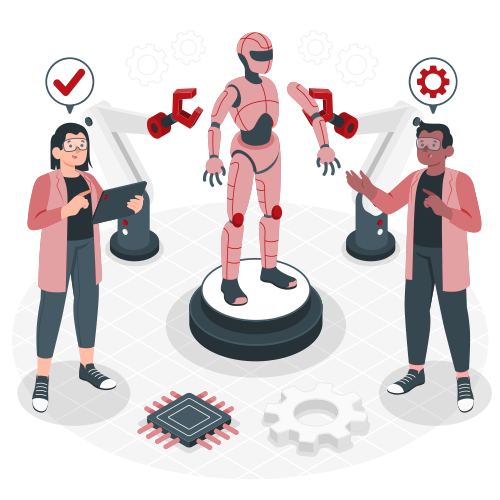
Une approche IA orientée métiers et résultats

Having AI doesn’t mean using AI. Most enterprise AI applications fail for predictable reasons:
- Initiatives launched in isolation
- Low adoption from non‑technical users
- No AI ready data pipelines
- AI workflows not aligned with business processes
- No structure for responsible AI or ethical AI practices
- Missing governance and no long‑term method
- AI agents created without clear business value
The result? Pilots that never scale, insights that never turn into measurable business outcomes, and AI investments that feel disconnected from reality.
Our approach to AI software solutions
AI software integration isn’t about choosing a tool.It’s about choosing the right architecture for your business. Our approach is based on:
- Technology‑agnostic decision‑making: We match your use cases with the right AI capabilities, from large language models to machine learning models or agentic AI.
- Interoperability first: AI apps must integrate with your systems, your enterprise data, your data sources, and your knowledge management layers.
- Scalability by design: AI software must support enterprise scale: large‑scale data, automated machine learning, secure data processing, and model‑driven architecture.
- Maintainability and ownership: You need solutions you can operate, evolve, and govern long term, not black boxes.
This is AI integration shaped around business outcomes, not hype.
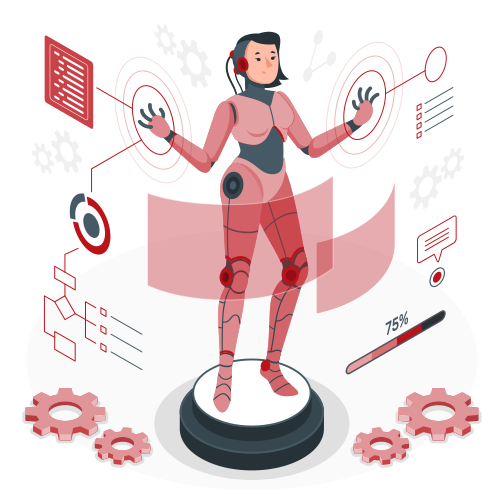
AI software solutions adapted to different maturity levels
No two organizations start from the same point. Enterprise AI only drives business value when it's designed around day‑to‑day operations.We adapt AI solutions to your stage of digital transformation.
Conversational AI solutions
AI assistants, enterprise chatbots, AI agents, and natural language understanding systems that automate repetitive tasks and enhance customer experience
Automation & orchestration solutions
AI workflows, automated workflows, agent orchestration, and predictive analytics pipelines that help you streamline operations.
AI embedded into business tools
AI features and AI powered insights integrated directly into Odoo ERP or your existing software suite, allowing businesses to unlock real productivity gains.
Technologies we use depending on your context
Large Language Model–based solutions (LLM software)
LLM-based solutions help you create, configure, or adapt custom AI agents, deploy AI solutions at scale, and build generative AI models aligned with your enterprise AI applications. They offer different levels of control, performance, and adaptability depending on your strategic needs.

Mistral AI
A fast, privacy‑focused model offering high control for enterprise conversational AI.

ChatGPT (OpenAI)
A versatile model suited for broad enterprise AI use cases and rapid iteration.

Claude (Anthropic)
A reliability‑driven model known for safe reasoning and long‑form comprehension.

Gemini (Google)
A multimodal model built for deep analysis, research workflows, and enterprise‑scale automation.
Automation & orchestration solutions
These platforms help automate repetitive tasks, orchestrate complex AI workflows, and streamline operations across systems; forming the backbone of scalable enterprise AI.

n8n
A low‑code automation tool that connects systems, workflows, and enterprise data.
👉See n8n in action → (link to sub‑page)
AI‑ready pipelines & data processing workflows
Structured workflows that prepare, transform, and operationalize business data for AI.
👉Explore AI pipelines → (link to sub‑page)
Agent orchestration tools
Software enabling multiple AI agents to coordinate tasks and deliver advanced agentic AI behavior.
👉Discover our agent orchestration approach → (link to sub‑page)
Odoo‑integrated AI software
AI features embedded directly inside your ERP, designed to enhance productivity, decision‑making, and operations within your existing Odoo environment.
Odoo AI‑embedded features
Native AI capabilities that accelerate everyday actions inside Odoo.
👉See Odoo AI features → (link to sub‑page)
AI‑powered workflows inside Odoo
Smart workflows that automate ERP tasks and surface insights instantly.
👉Explore Odoo workflow automation → (link to sub‑page)
Contextual AI insights in business processes
AI powered summaries and recommendations built directly into ERP operations.
👉Learn more about AI in Odoo business processes → (link to sub‑page)
AI infrastructure components (the technical foundations)
Before deploying conversational AI, automation, or AI agents at enterprise scale, organizations need a solid technical foundation. These components aren’t standalone software solutions.They operate behind the scenes to ensure accuracy, performance, reliability, and governed AI deployments.We rely on infrastructure elements such as:
- Vector databases, used to process unstructured data and support semantic retrieval
- Knowledge indexing and knowledge management layers, enabling enterprise‑wide search and context
- RAG connectors, which combine large language models with your business data
- Model‑driven architecture foundations, ensuring scalability and consistency across AI systems
- AI‑ready data pipelines, preparing and structuring data for AI workflows
Together, these components provide the stability and intelligence required to power reliable enterprise AI applications.
What turns AI software into a sustainable performance lever?
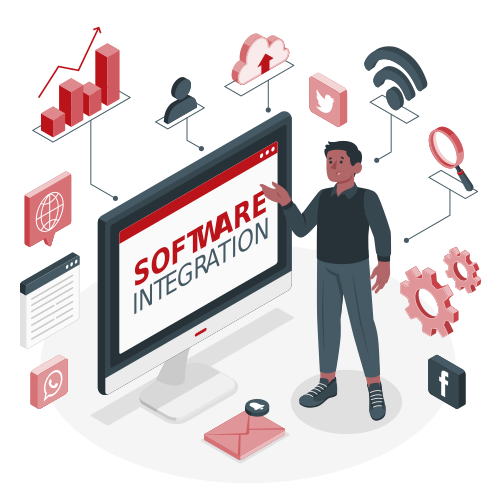
AI creates value when it’s deployed, adopted, and optimized, not when it’s tested.What makes AI software work long term:
- Business use‑case framing: Focus on measurable business outcomes and business value.
- Process integration: Align with enterprise workflows, enterprise data, and non‑technical users.
- Customization & tailored solutions: AI software must reflect your business logic, not generic templates.
- Security & data protection: Responsible AI and ethical AI practices built into every step.
- Continuous optimization: AI training, AI expertise, and iteration cycles that keep models accurate.
This is how enterprise AI becomes a growth engine, not a cost center.
Captivea’s method for integrating and scaling AI software
This is where expert integration makes the difference and where Captivea steps in with a method designed for real, long‑term adoption
1
Acculturation
2
Industrialization
3
Scale
Captivea helps global enterprises:
- Deploy AI solutions aligned with your AI principles
- Leverage AI across your integrated suite
- Rapidly build and rapidly develop new AI apps using the right platforms
- Streamline operations with AI workflows
- Orchestrate automated machine learning across data sources
- Support non‑technical users through intuitive AI assistants
- Ensure responsible AI aligned with governance standards
Our role is simple:Turn AI into a practical, scalable, measurable asset.
Identify the AI solutions that fit your organization
A short conversation is often the fastest way to understand where AI can boost productivity, create business value, and simplify complex challenges.We can help with:AI maturity assessment, exploratory workshop, use‑case mapping, data readiness evaluation. Let’s align the right tools with your goals.
Frequently asked questions
AI models are built for specific tasks (classification, prediction), while large language models support natural language understanding, generative AI models, and conversational use cases at enterprise scale.
Yes. AI assistants help automate repetitive tasks, provide faster responses, and deliver AI powered insights, improving satisfaction across channels.
They ensure your business data is clean, structured, and accessible for AI deployments, enabling accurate outputs and streamlined operations.
Absolutely. Most enterprise AI applications are designed so non‑technical users can leverage AI capabilities through simple interfaces.
They enable AI systems to process unstructured data, retrieve context, and generate actionable insights, especially with agentic AI and retrieval‑augmented workflows.
Through ethical AI practices, governance frameworks, data protection standards, and continuous monitoring across all AI deployments.
Yes, when tied to workflows. AI can boost productivity, reduce manual work, automate repetitive tasks, and deliver cost savings.
Not anymore. AI software development, predictive analytics, and automation frameworks allow businesses of all sizes to leverage AI and gain a competitive edge.
AI agents operate autonomously, adapt to context, analyze data, and take decisions, creating more dynamic and scalable AI applications.