
What is Technical Debt?
An invisible roadblock for your business
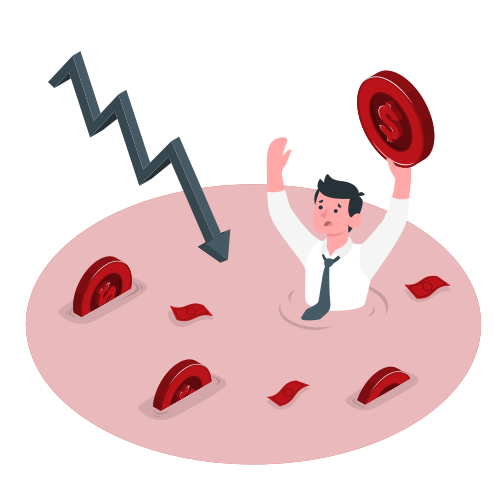
Technical debt refers to the accumulation of quick-fix solutions designed to meet immediate needs but that ultimately makes system maintenance and evolution more complex over time. It’s like poorly executed construction work—it holds up… until the day everything collapses.
In an ERPIn an ERP, technical debt often takes the form of:
- Heavy, custom developments that are expensive to maintain,
- Incompatibilities with system updates,
- An overload of modules and external integrations.
Direct consequences
Technical debt leads to additional costs and makes your ERP more rigid:
- Updates become expensive projects: When custom developments are implemented without a long-term vision, every update requires significant adjustments and fixes. You’ll need patches for every upgrade, creating unexpected costs and delaying the deployment of new features.
- Your ERP slows down: An overloaded ERP system filled with unnecessary code loses efficiency and becomes harder to scale. Slow performance and complex processes not only hinder daily operations but also prevent you from leveraging new functionalities. Too many layers, not enough optimization!
- You lose agility: Constant maintenance diverts technical resources from strategic, innovative projects, reducing your company’s competitiveness. Instead of fueling business growth, time and money are wasted on keeping the system running.
Odoo: An ERP designed to minimize Technical Debt
Extensive functional coverage
Odoo Odoo already addresses a wide range of business needs—CRM, accounting, manufacturing, e-commerce, HR, and more. Many companies underestimate the power of the standard system and rush into custom development, even when built-in features already exist. Before customizing, it’s best to explore what Odoo offers out of the box.
Scalable and standardized architecture
A standardised ERP doesn’t mean a rigid one. Thanks to its modular approach, Odoo makes updates seamless without the need to rewrite code. Many elements can be configured without heavy customisation. By staying close to the standard, your organisation can evolve its ERP without major constraints. Plus, Odoo releases new versions every year, with updates that enhance performance and security. A minimally modified ERP benefits fully from these improvements without costly corrective developments.
A rich ecosystem of ready-to-use modules
Need an extension? The Odoo App Store offers thousands of pre-tested modules. Instead of developing custom features, businesses can rely on these validated and maintained applications, ensuring better compatibility with future updates.
What to do if your Odoo is already affected by Technical Debt?
Prioritise the standard: configure instead of coding
Odoo provides a variety of configuration tools that allow you to tailor the ERP to your business needs while maintaining a standard approach, without the need for custom development:
- Odoo Studio: Customize the interface and fields without any coding
- Automations: Streamline workflows without adding unnecessary complexity to the ERP
- Native & Open APIs: Connect Odoo to other software without overloading the system

Define the project properly from the start
Proper planning means fewer surprises and unexpected issues. Before implementation, you should:
- Identify your true business needs,
- Assess what Odoo’s standard features can already handle,
- Define an adaptable and scalable roadmap.
Map out your existing processes and select the appropriate modules. Future changes are anticipated, and unnecessary developments are avoided.

Limit custom developments to truly necessary cases
Customisations should always be approached in a structured and controlled way. If overdone, they can increase maintenance costs and hinder ERP updates. However, customisation may be necessary in specific situations:
- Unique business processes that are not covered by the standard,
- Legal or industry-specific requirements that need tailored solutions,
- Advanced automation is not available in the native system.
In all other cases, it’s better to adapt your processes to the standard. Before you think about creating a custom module, assess whether an existing solution works. Is it essential? Can it be handled with existing tools? Is there a solution in the App Store? Ask yourself the right questions!
Leverage Odoo best practices
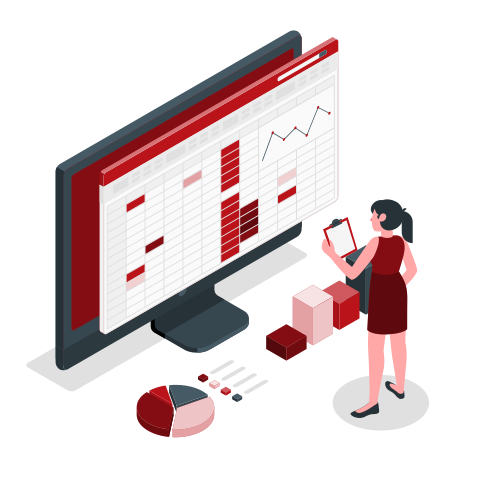
The goal of an ERP is not to be 100% standard or 100% customised, but to find the right balance between flexibility and simplicity. Too much customisation can make the system rigid, while too much standardisation may limit specific needs. For Odoo, however, you can rely on several actions to minimise the risk of technical debt.
- Use built-in workflows and automations,
- Prioritize advanced configurations over custom development,
- Integrate rather than overload (using APIs and native connectors).

What to do if your Odoo is already affected by Technical Debt?
Audit the existing system
A review of custom developments helps identify problematic areas and assess their impact on system performance and evolution. To know where to act, you should analyse:
- Unnecessary or outdated modules,
- Custom developments that block updates,
- Underutilized standard features.
Streamline custom developments
Some outdated or redundant modules can be removed or replaced with more suitable solutions. The goal is to simplify the ERP architecture and improve its maintainability. By removing unnecessary layers, you make your system more agile. This may include:
- Replacing complex customizations with simpler solutions,
- Merging redundant modules,
- Optimizing integrations to avoid conflicts between extensions.
Plan for a return to greater standardisation
If the ERP has been overly customised, it may be necessary to revert to a version closer to the standard. This doesn’t mean starting from scratch, but rather streamlining the architecture to gain more flexibility. By doing so, you can take advantage of Odoo's ERP software updates, make team training easier, and optimise your maintenance costs.
Technical debt is a major challenge when implementing an ERP. By adopting a structured approach and leveraging Odoo’s standard features, you can minimise these risks and ensure a scalable and high-performing system. Less code = Less technical debt = More scalability and fewer additional costs.
At Captivea, we help you get the most out of Odoo without falling into the technical debt trap. Let’s talk!