
ERP serving the entire medical ecosystem
Whether you are a manufacturer, pharmacist, or distributor, a specialized ERP gives you a complete and reliable view of your operations. You gain peace of mind in the face of regulatory requirements and protect your supply chain to ensure the quality of patient care.
Learn more about the features of an ERP for the healthcare and pharmaceutical sectors
Pharmaceutical industry: compliance and traceability
You operate in a highly regulated environment where every product must meet strict requirements, such as Good Manufacturing Practices (GMP). With an ERP, you centralize all quality processes and ensure automatic compliance.
Producing medications or medical devices requires absolute precision. An ERP allows you to automate quality controls at every stage, from raw material reception to production and packaging. Each batch is continuously tracked, from manufacturing to distribution. You have a complete history, ensuring full transparency in the event of a product recall or regulatory inspection.
Consider the example of a pharmaceutical company that must test each batch of medication before shipment. With an ERP, test results are recorded directly and compared against validation criteria. If a batch shows an anomaly, it is immediately isolated and an alert is sent to the relevant teams.
Pharmacies and retail locations: optimized inventory management
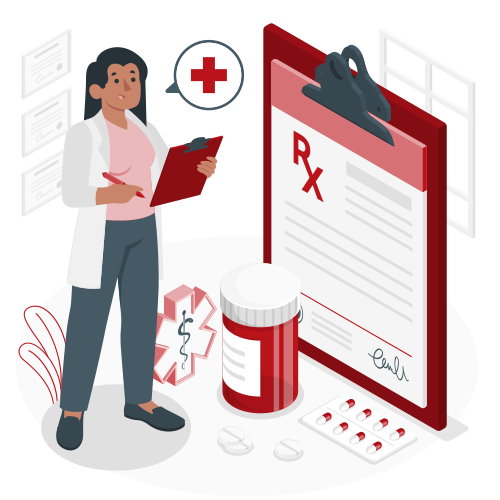
In a pharmacy, every box of medication counts. A stock-out can put a patient’s health at risk, while overstocking leads to financial losses. Managing inventory manually is a real headache: between fast-moving products, prescription medications, and those subject to quotas or strict expiry dates, every mistake can directly affect business operations and customer satisfaction. An ERP provides real-time stock updates and meticulous tracking of inventory movements. No need to wait for a physical inventory to know which products need to be reordered: the system detects critical thresholds and can automate orders to suppliers.
Repetitive tasks such as managing prescriptions, processing payments, and verifying batches can slow down pharmacy operations. An ERP connected to your point-of-sale software automates these steps, ensuring faster and more reliable service. To offer personalized patient follow-up and enhance their experience at your pharmacy, you can use the CRM integrated into your ERP. This allows you to:
- Offer automatic reminders for prescription refills
- Set up loyalty programs with tailored recommendations
- Manage purchase history for more relevant in-store advice.
Hospitals and medical groups: simplified administration
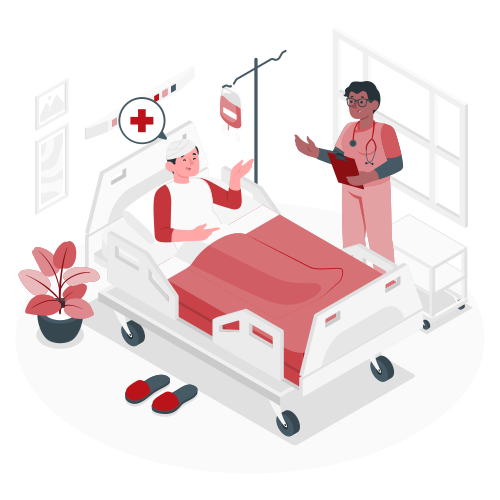
With a tailored ERP, hospitals and medical groups gain in responsiveness and accuracy. Administrative burdens are a thing of the past: teams can focus on their primary mission — providing quality care to patients.
Billing, accounting, human resources management... In a hospital or a network of clinics, these services often operate with different tools, leading to duplicates, information loss, and unnecessary delays.
With an ERP, all these data are consolidated into a single system, providing a complete, real-time view of finances and operations. Administrative teams can access information with just a few clicks, avoiding errors caused by manual data transfers.
Here are some examples of processes that an ERP can simplify:
- Simplified and secure billing: automatic generation of invoices based on medical procedures performed, integrated payment tracking, and reminders.
- Streamlined medical scheduling: automatic assignment of caregivers based on needs and availability.
- Efficient human resources management: automation of pay stubs, tracking of training, and certification of health care staff.
Efficient management of patient records through the integration of Electronic Medical Records (EMR)
Emergencies, consultations, surgery, post-operative follow-up... In a health care facility, patients move between different departments and are cared for by various teams. Without proper coordination, information loss or delays in transmission can directly impact the quality of care. With an ERP integrated EMR, all medical data is centralized and accessible in real time:
- A complete care and treatment history, instantly available for each practitioner.
- Elimination of duplicates and medical errors through a unified database.
- Improved communication between teams, whether within the same hospital or across multiple facilities in a medical network.
An ERP ensures the secure storage of patient records, controlled access based on user rights, and automatic compliance with regulations (GDPR, HIPAA):
- Encryption and secure storage of patient records.
- Restricted access and traceability of consultations: only authorized professionals can view or modify a record.
- Automatic updates based on legal changes for continuous compliance with health care data protection regulations.
The integration of Electronic Medical Records (EMR) into an ERP enables instant access to patient information, supporting timely care while ensuring security and compliance.
Digitizing the patient relationship
The digital era has transformed patient expectations, with a focus on speed, accessibility, and simplicity throughout their health care journey. An ERP can streamline appointment management and improve communication between health care facilities and patients.
Online appointment booking and calendar management
No more endless calls to find an available slot! With an online appointment scheduling module, patients can book in just a few clicks based on real-time updated availability. On their side, practitioners optimize their schedules and reduce gaps in their calendars. For example, a patient can view a specialist's available slots and book directly through an online platform, without going through the secretary.
No-shows are common and lead to wasted time and money for healthcare professionals. The ERP can send automatic reminders via SMS or email, significantly reducing absences and improving appointment management.
Developing patient portals for online follow-up
Accessing medical history or retrieving test results becomes quick and straightforward. No need to wait for a phone call or an in-person visit: everything is available online through a secure interface. The portal also enables direct communication with your doctor, sending medical documents, and receiving recommendations, all while ensuring data protection in line with current regulations. Imagine you’ve had a scan—you can view your results from home as soon as the lab makes them available.

Security and compliance for medical data

Compliance with regulations (GDPR, health care data protection)
Between GDPR in Europe, HIPAA in the United States, and other specific standards, healthcare institutions must ensure strict management of medical data. The ERP system centralizes this information while applying robust security protocols. Modern systems also integrate encryption mechanisms, strong authentication, and access traceability, helping protect data from intrusion or leakage. With an ERP that complies with current regulations, healthcare facilities secure sensitive data while ensuring patient confidentiality.
Automating audits and quality controls
Healthcare facilities and pharmaceutical companies must comply with strict standards for quality and data management. A medical ERP supports this compliance by automating internal audits, quality controls, and regulatory reporting.
With integrated tools, institutions can monitor procedures, identify discrepancies in real time, and initiate corrective actions without waiting for an external audit.
Improving transparency and traceability
In a sector where every action must be documented and justifiable, an ERP enables complete traceability of medical data, medications, and interventions. Structured access to information also strengthens trust among patients and regulatory bodies while reducing the risk of errors or fraud.
A hospital can track the full history of a medication, from its procurement to its administration to the patient, ensuring rigorous and secure management.
ERPs are transforming the healthcare sector by optimizing inventory management, scheduling, and data. They simplify administrative processes and support better coordination of care while ensuring compliance with standards. Choosing the right solution is essential to fully leverage these tools. The future of ERPs in healthcare is promising, with strong prospects for continuous improvement in the management of care and services.
Talk to an ERP expert from Captivea, specializing in Odoo integration, to discover how our solution can transform your daily operations.